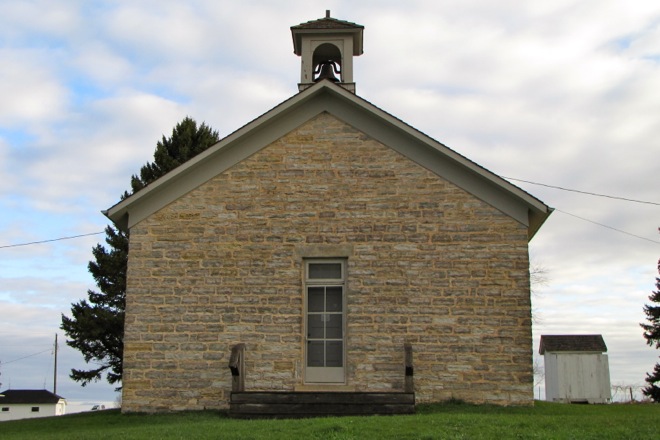
According to the outside historic marker, the stone Locust School building in rural Winneshiek County was in operation for 106 consecutive years, an Iowa record. Built in 1854 from local limestone, the school served the newly-settled village of Locust. In 1965, five years after the school’s closure, the Locust School Society was formed to preserve the historic one-room school building. It’s now operated by the Winneshiek County Historical Society and open to visitors Saturday and Sunday afternoons from 1 to 4 p.m. each June through August.
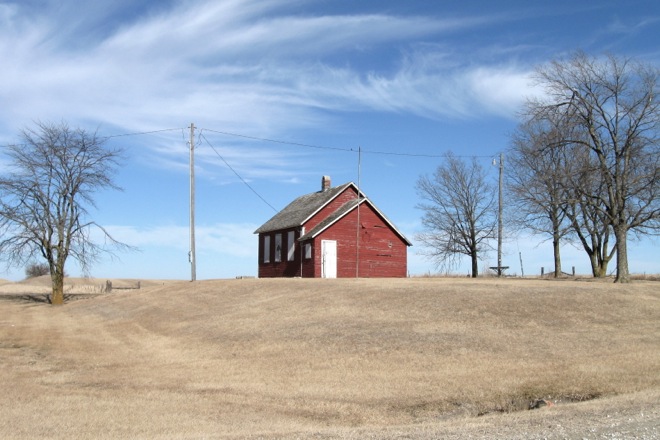
Located three miles north of Lineville in rural Wayne County, the Pleasant Hill Rural School building was constructed in 1881. For years, it maintained a “Tickle Grass” nickname and was panted white; in the 1940s, a red coat of paint was applied, and the one-room school building became known by locals as the “Little Red Schoolhouse.” The school’s last year of operation was 1957.
The schoolhouse served as a roadside park in the 1960s, with the state of Iowa adding a 90-foot driveway across the ground. Picnic tables were provided by the Wayne County Conservation Board, while the Wayne County Historical Society was responsible for maintenance efforts.
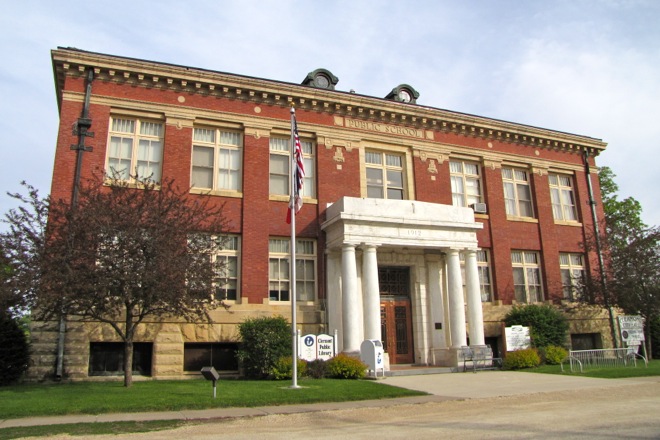
Former Iowa Governor William and Anna Larrabee spent many years studying school buildings before creating plans to build a state-of-the-art school facility in their hometown of Clermont. Groundbreaking began on the $100,000 brick building in May 1912. The Clermont website details interior features:
The floors of the vestibule and halls are terraza with wainscoting of white Rutland marble with sufficient veins of red and green to show warmth. The stairs also have marble treads and metal railings finished in dark green. All glass is plate – with nearly 5 ton in the entire building. Each classroom has blackboards of extra heavy Pennsylvania slate. The Auditorium… walls and ceiling are white, decorated with staff and bead and rosette designs.
The Larrabee Building served as a community school until 1990. When classes were consolidated to a single school building constructed between Clermont and nearby Elgin, the building was repurposed to serve the community. The public library moved in in 1991. The building also houses city offices, the police department, and the Sheehan-Olson American Legion Post.
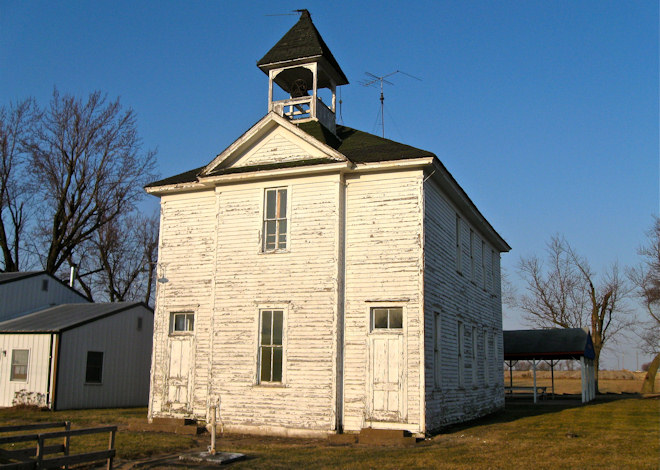
In 2009, the city council in the Keokuk County town of Hayesville voted unanimously to demolish West Lancaster School #9, which had been a fixture in the community for over a century. In addition to serving students, in its heyday, the two-room country school served as a mayor’s court and a gathering place for lawn movies shown on the school’s back wall.
In the 1960s, the school closed and has been used only sparingly as a polling space since. Before its demolition, it suffered from a crumbling foundation, interior led paint and a ruined roof. The cost to preserve and remove the school would have exceeded $100,000.
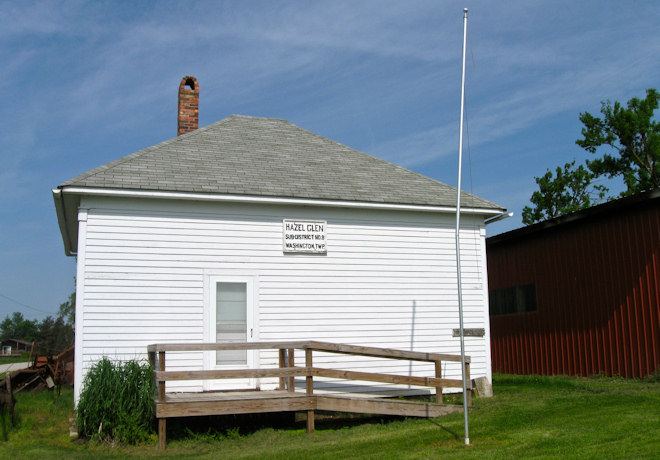
The Hazel Glen one-room schoolhouse was originally constructed in 1912 to serve students in Washington Tonwship in western Ringgold County. When the county school was closed, the building was moved to the school grounds in the county seat of Mount Ayr where it was used as a classroom until 1979. The century-old school has since been restored and is now part of the Pioneer Museum complex in Ellston. It’s open summer Sundays from 1:00 to 4:00 or by appointment at (641) 464-2140.
Featuring a new Iowa photo each weekday; dedicated to discovering and documenting the best of small-town Iowa.